
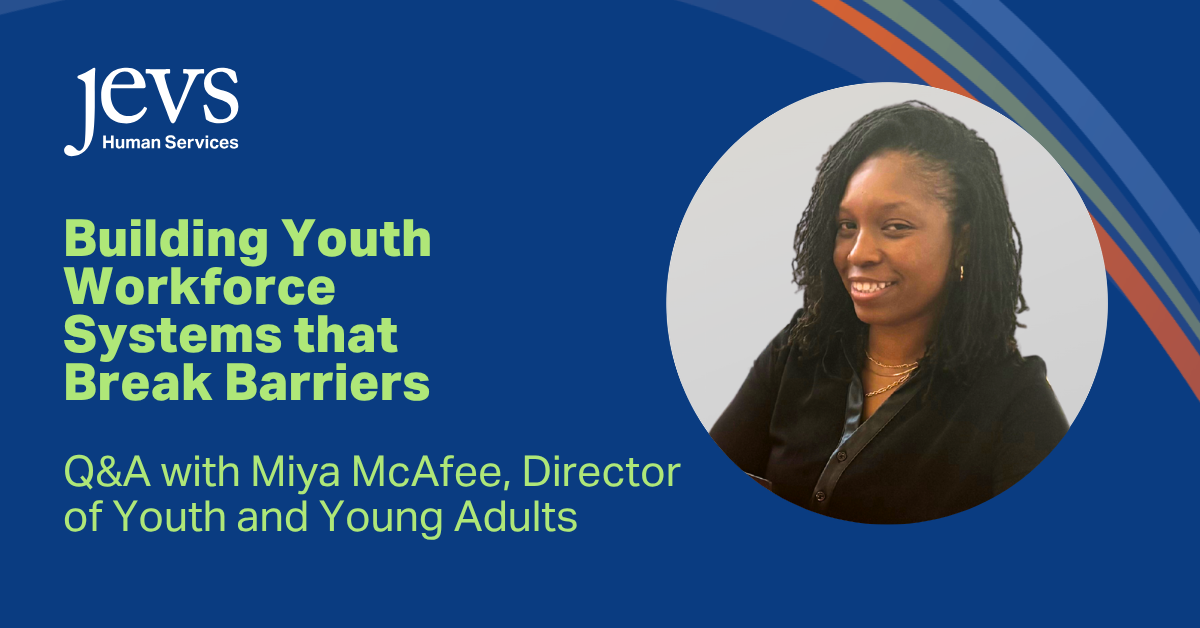
In recognition of Women’s History Month, we’re highlighting the voices of women across JEVS Human Services (JEVS) who are making a meaningful impact through their work and leadership. We recently connected with Miya McAfee, Director of Youth and Young Adults at JEVS. JEVS is the intermediary for Career Connected Learning – Philadelphia (C2L-PHL), and Miya’s work in the youth workforce sector spans nearly two decades with participant, provider, and funder role experiences.
How did you decide on a career in youth workforce development?
I started working in youth workforce development in 2008—without realizing it would become my career.
At the time, I was a seasonal employee, managing the process of working with youth providers to offer summer work-based learning opportunities for young people in Philadelphia.
I didn’t realize it then, but that job led to a series of positions working for Philadelphia Youth Network, North Light Community Center, Philadelphia Works, and finally JEVS. My own work-based learning experience turned into something much bigger and fueled a career I’m passionate about.
How did you find your way to JEVS Human Services?
In many ways, my role of Director of Youth and Young Adults at JEVS brings together everything I’ve experienced professionally.
My initial experience in supporting paid-learning opportunities for young people flowed naturally into working with those same young people as a provider, and eventually into positions with organizations that drove funding to learn, build, and advocate for a system that worked for young people. Throughout the roles I’ve held, I’ve worked with incredible teams, built relationships, and supported youth in navigating complex systems.
What do you enjoy most about the work you do?
My career has happened because someone created a space for me to learn, grow, and be seen. So, what I enjoy most is advocating for the intentional creation of opportunities for young people early on that will do the same.
Because work-based learning is so much more than a job, and young people need to be included in the conversations about what a sustainable workforce looks like.
For some young people, introductions to work through opportunities like C2L serve as their first paycheck. For others, it’s a chance to explore what they want – and don’t want – to do. For many, it’s about stability—helping their families, supporting themselves, or simply staying on track.
I work to support Philadelphia youth navigating real barriers—housing instability, family responsibilities, and uncertainty about their futures. Work-based learning opportunities are stepping-stones to their futures; work-based learning opportunities become lifelines to independence and economic security.
I’m committed to continuing to build systems that don’t just serve young people—but truly support them, uplift them, and open doors they didn’t even know existed.
What advice or perspective guides your work?
The perspective that guides me is always keeping young people at the forefront and creating a space that empowers them to gain workforce experience: so that, regardless of different backgrounds and resources, they can get a foot in the door to future employment that sustains their lives and dreams.
I am grateful to have gained professional experience at Philadelphia Youth Network under the leadership of Stacy Holland and Laura Shubilla. While there, I looked to leaders such as Stephanie Gambone and Chekemma Fulmore-Townsend as models of youth advocacy in employment and education and strove to emulate their drive and future-focused thinking. Those initial representations of strong female voices continued into my time at Philadelphia Works. There I was fortunate to continue learning and building systems alongside Kimberly McCaffrey and Liz Pisarczyk, initially a small team of three, including myself. We each have an overwhelming passion to break barriers to access for young people and establish long standing and sustainable opportunities for economic mobility through education and employment for youth and young adults in this city.
As I reflect over the years, I see the ways that youth workforce systems are growing. We’ve moved from paper applications to digital systems where young people can create profiles, track their progress, and return year after year without starting over. We’ve reduced barriers for youth who once fell through cracks, particularly those without easy access to documents or stable support systems.
Every year, thousands of young people apply for these opportunities—yet not all of them are able to access them. For example, in Summer 2025, as the intermediary for C2L-PHL, JEVS enrolled over 7000 youth in work-based learning opportunities, with almost double the number of applications. That tells us something important: the need is substantial. So, the work isn’t done, but I’m hopeful, because I’ve seen what’s possible, and I’ve seen the impact.
The question we must keep asking is, how do we make these opportunities more accessible, more effective, and more meaningful for young people?
And then make the decisions that move us farther in that direction.
Posted in Blog